The Rangiuru Business Park is a transformative regional development with a 20+ year legacy, built on shared values and a commitment to intergenerational outcomes that span financial, social, cultural, and environmental dimensions. Through leveraging the strength of the Council’s balance sheet, alongside specialist property development expertise, Quayside has funded and led the development to where it is today.
It is an enabler for the Bay of Plenty community and exemplifies a shared commitment to regional economic growth, technical excellence, and meaningful cultural and ecological outcomes that will have a lasting impact.
Development & Sales Update
Rangiuru Business Park transitioned from early-stage delivery to active use this year.
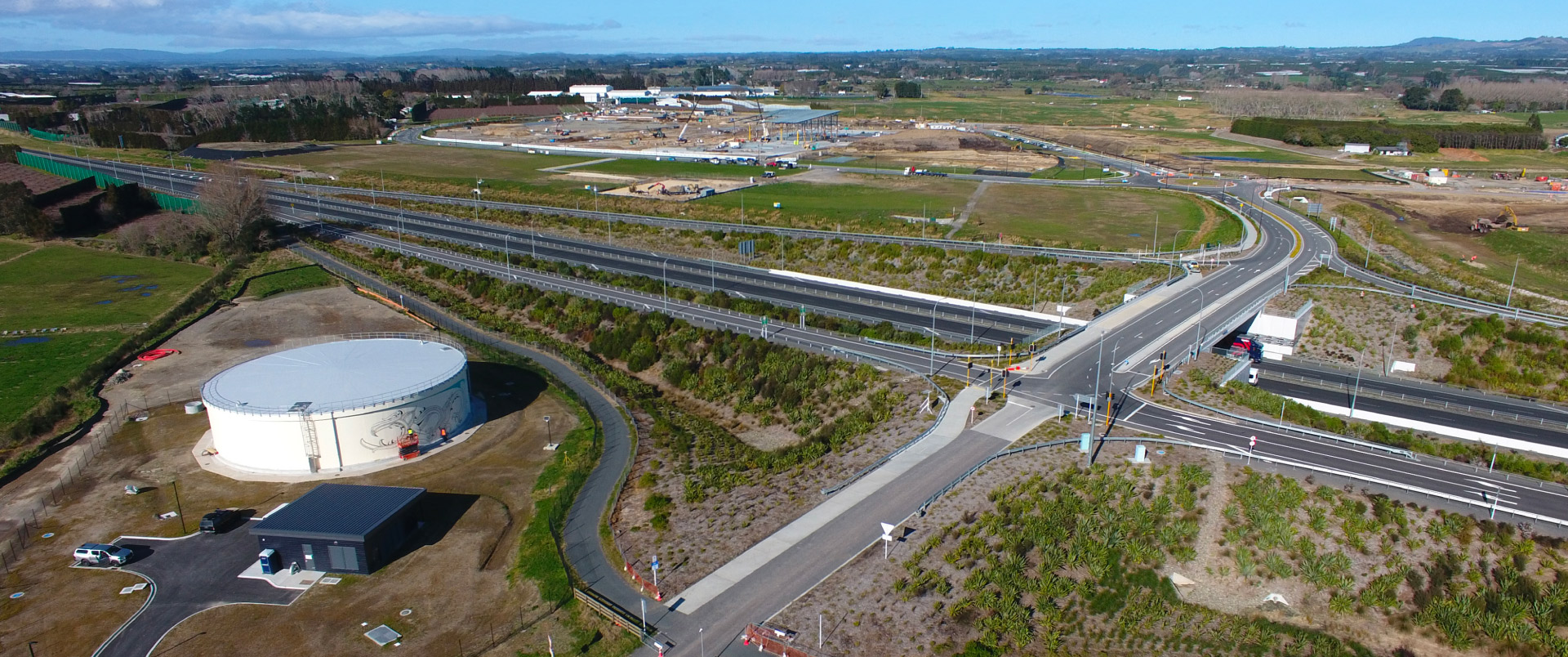
Key bulk infrastructure is now in place. The motorway interchange is operational, internal roads are complete in Stage 1, and core utilities have been delivered. We continue to construct roading networks that will enable future stages of the Business park to develop.
Sales have followed with the first land parcels in Stage 1, which have been transacted, including an 8.7 ha site for a high loading packhouse and cool storage facility for Jace Group. The site will see a large-format industrial facility with high logistical, stacking, and transportation needs, with construction underway, we will see development coming out of the ground in the coming year. Additionally, Super Yacht Coatings purchased Lot 81 with motorway visibility and Lot 82 purchased by Acacia Land Holdings, to join as their neighbours. Titles have been issued and vertical development on the sites has begun.
Rangiuru Business Park has evolved in response to market-driven changes. Unlike residential developments, where lot layouts are typically fixed, industrial developments must remain flexible to accommodate purchaser demands. This required the entire team — developer, consultants, and contractors — to be agile and ready to pivot quickly and at any time.
These changes were frequent and sometimes occurred during the course of construction, necessitating rapid adjustments across supply chains while minimising impacts on cost and programme.
The Rangiuru Business Park team on the ground has expanded and contracted to meet the needs of the development activities. Last year, we had seven main contractors operating within the site simultaneously, which was an unusually high level of integration for a project of this scale. This year, due to the work schedule, there are 7 – Higgins, Bay Civil, HEB Construction, JMC Civil Construction, Tree Wise Men, Treeline and Tapuika Iwi Authority. The team have cultivated a culture of shared responsibility, particularly around health and safety and environmental management, where contractors were encouraged to think collectively rather than individually. This has been reinforced through fortnightly all-contractor meetings focusing on environmental performance, site logistics and interface, along with site wide H&S events and reward recognition.
With multiple contractors working simultaneously across different fronts, the team navigated overlapping work areas and scopes and high interdependency through disciplined coordination and proactive engagement with regulatory bodies like the Western Bay of Plenty District Council and Bay of Plenty Regional Council.
People & Relationships
For Quayside, relationships are central to the way we work. This is expressed through our organisational values: Our People, Our Strength, Authentic Relationships and Purposeful Stewardship. At the business park, those relationships have been built across every part of the development: with mana whenua, contractors, consultants, local authorities, purchasers, tenants and the wider regional community.
The scale of the project is evident in the number of people and businesses it has touched. For Mike Speed, General Manager of Bay Civil, Rangiuru Business Park has had a direct impact on local workers, subcontractors and their families. “Across our direct staffing group, over three-quarters would have spent some time out at Rangiuru. On top of this, there would be another 50-60 subcontractor resources who have also been involved. Think of the families that this supports.” That impact was particularly meaningful in a difficult market. Mike described Rangiuru Business Park Stage 1a Civils as “a lifeline for our business,” noting that the timing came “just as the market entered a downturn” and helped support the team and their families through that period.
The project’s delivery model also created opportunities for local and medium-sized contractors to participate in a development of regional significance. Mike Speed said Quayside’s decision to award works in modest-sized packages “enabled medium sized contractors to put their hands up to be involved,” ensuring local resources benefited from the project works.
For Higgins, the motorway interchange became more than a piece of infrastructure. Dean Taylor, Regional Manager, Higgins Bay of Plenty, said: “Our team of almost 200, over the life of the project, not only delivered a piece of transport infrastructure but they created a critical gateway to a development that will help shape the future of the region.”
The same theme of partnership carried through the wider contractor group. Andrew Hiscox, Area Manager at HEB Construction, said the project helped establish “a strong new working relationship with the Quayside team” and reinforced that “the value of collaboration far exceeds working in isolation.”
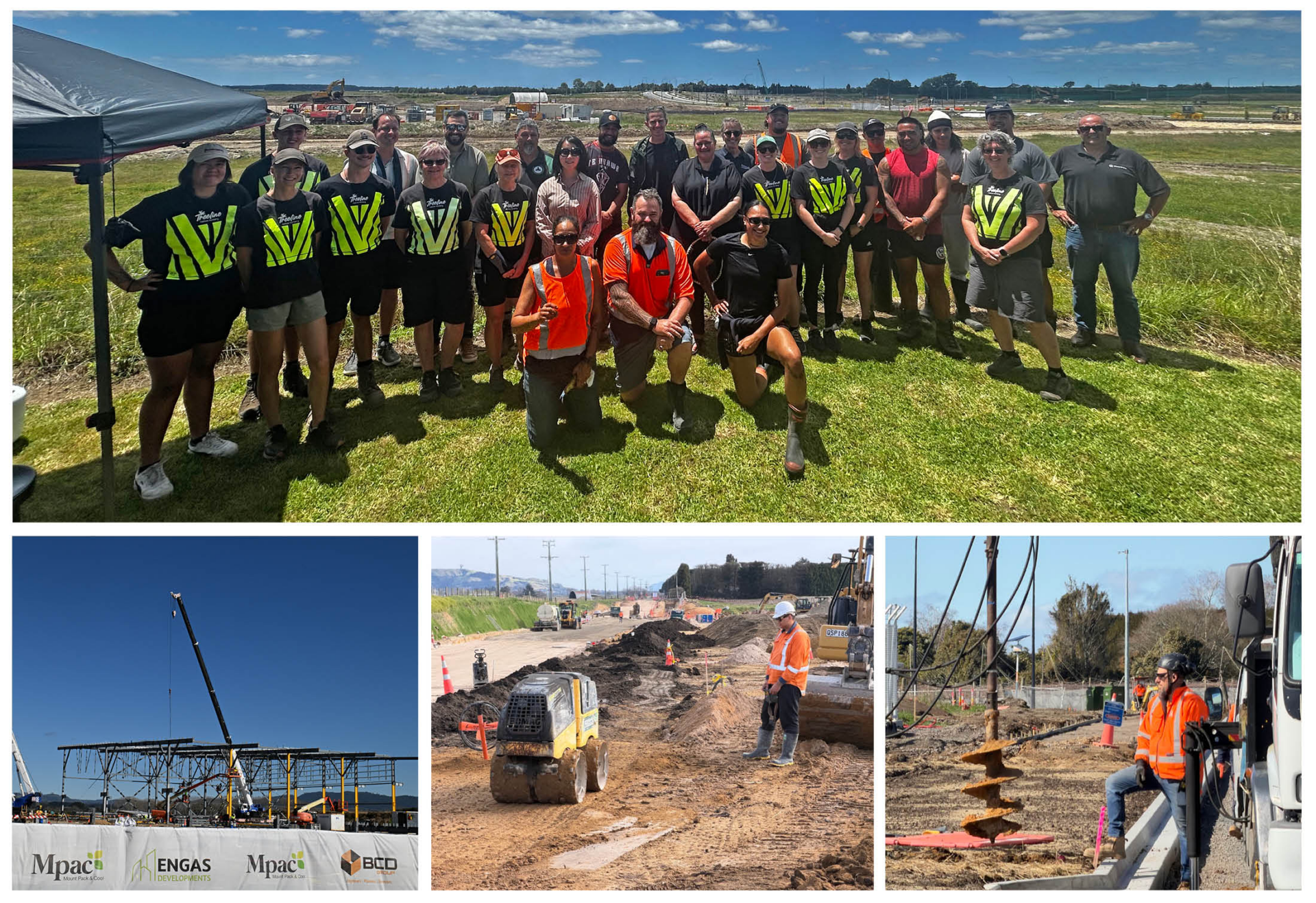
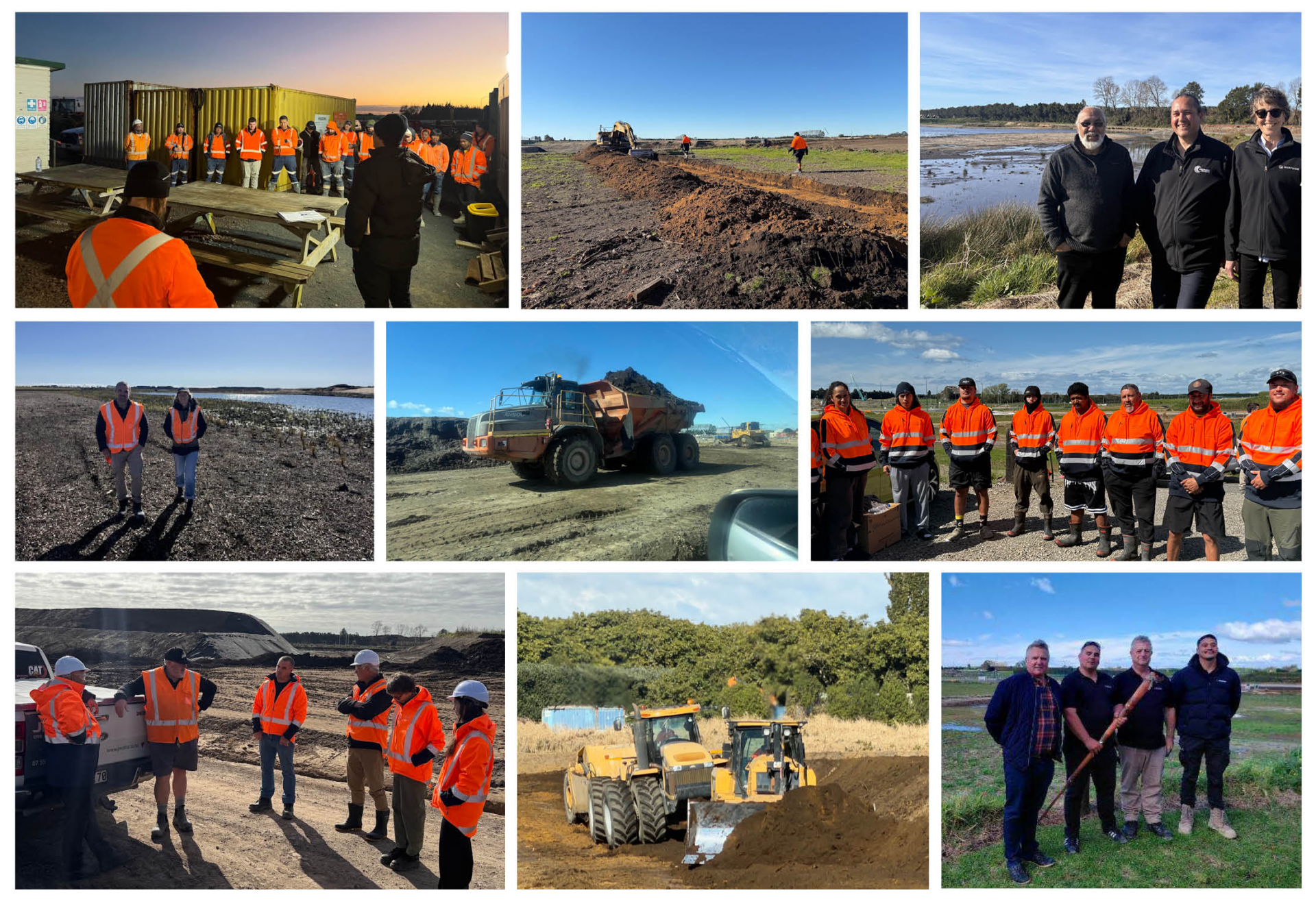
Many of the contractors and consultants have been involved from the beginning, including local Bay of Plenty contractor JMC. Jason Mather says, “Across the programme, JMC and Quayside have worked closely to maintain high standards of environmental control, including erosion and sediment management, dust suppression, stormwater controls and site stabilisation. It has required practical problem-solving across changing ground conditions, weather events and multiple contractor interfaces.” He adds, they’re proud to have contributed to the physical platform that will support future investment, employment and regional growth at Rangiuru Business Park.
Long-standing partnerships have also been critical to navigating a project that has evolved over more than two decades. Harrison Grierson, Head of Clients & Markets, Andrew Collins shares, “The opening of the interchange was a proud moment because it reflected the contribution of so many people over such a long period of time. We’ve worked alongside Quayside on Rangiuru Business Park since the earliest feasibility and planning stages, and what has always stood out is the commitment to creating lasting benefits for the region. Projects of this scale don’t happen without strong relationships, shared goals and the willingness to adapt as the project evolves.”
The relationship with Tapuika Iwi Authority has been central to the development of Rangiuru Business Park. Since formalising a Relationship Agreement in 2021, Quayside and Tapuika have worked together to advance cultural, environmental and economic outcomes. During the past two years, this has included the naming of roads and infrastructure assets, employment and training opportunities, cultural storytelling, wetland planting and cultural monitoring, alongside ongoing engagement and cultural inductions for contractors.
Tapuika Iwi Authority Kaiwhakahaere / General Manager, Te Hingatū Marsh shares, “Over time, the relationship between Tapuika and Quayside has grown into one based on mutual respect and a genuine commitment to achieving meaningful outcomes together. It is important to Tapuika that we honour the whakapapa and stories of our whenua while working to fulfil our aspirations, uplift our people and create opportunities for future generations. The Quayside team have demonstrated that commitment through contracts and employment opportunities, leaving an everlasting impression on Tapuika because of their authentic and genuine desire to see our people succeed. One example that stands out was when Quayside team members joined us for our Waitangi Day, Tūhono ki te Awa nui o Tapuika, River Day. It opened minds from the iwi’s perspective and helped put a face to the business park.”
Ecological Outcomes
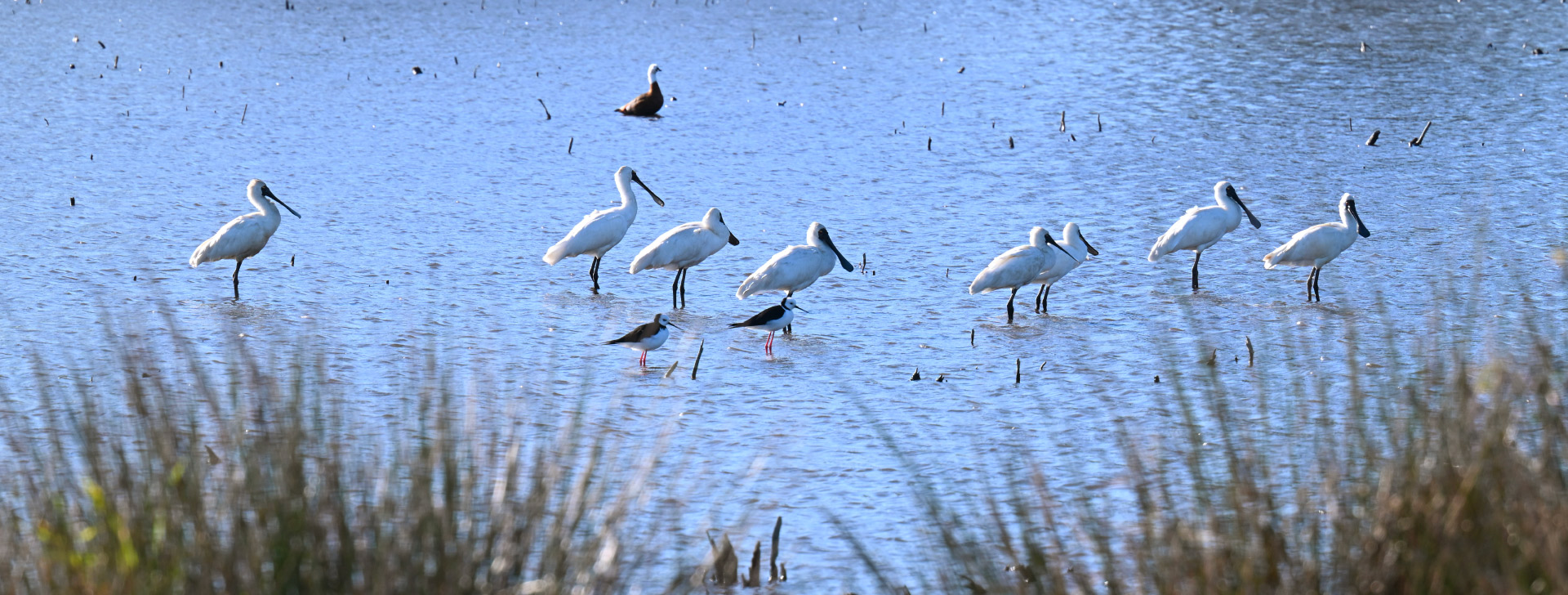
The Te Haukōpūpū wetlands at Rangiuru Business Park are continuing to demonstrate the environmental value of integrating ecological infrastructure into development.
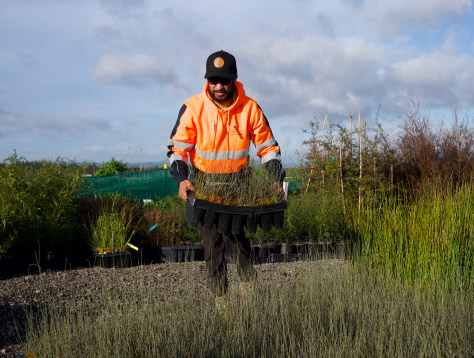
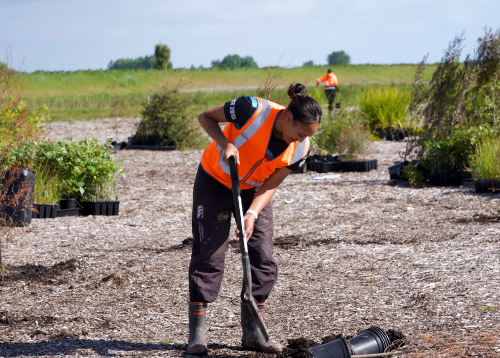
For the project team, planting over 360,000 eco sourced plants into Te Haukōpūpū has been the achievement of a goal set back in 2021 when the business park’s first sod was turned. The intention to design a stormwater pond that reflects the repo of the past generations, bringing back both plant and animal species that once called this region home, including the Kahikatea and the Matuku hūrepo, while improving the water quality as it tracks its way back to the Kaituna River. Seeing that vision realised has been deeply satisfying for Quayside.
During the past year, Tapuika completed its first six months of maintenance, caring for two seasons of planting and focusing on early pest plant control and monitoring the health of native species. Despite challenging weather conditions, the diverse mix of sedges, grasses and native trees is establishing well, providing natural stormwater filtration while creating habitat for new wetland ecosystems. The results are already visible, with biodiversity increasing and a growing number of native bird species making the wetlands their home.
For Te Hingatū Marsh, the wetland development shows what the partnership means in practice. “For Tapuika, it is working in collaboration to develop the stormwater pond and seeing biodiversity, flora and fauna returning to the land. This is significant for us all.”
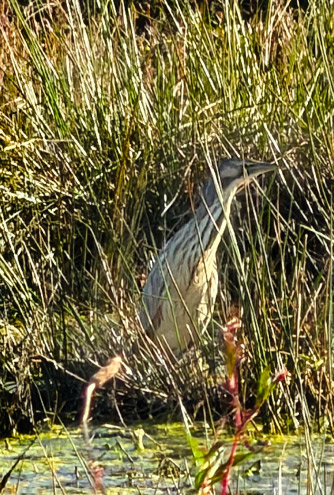
Among the species recorded are the Royal Spoonbill (Kōtuku ngutupapa), White-faced Heron (Matuku moana) and, most notably, the nationally threatened Australasian Bittern (Matuku hūrepo), a species whose numbers have declined significantly as wetland habitats have been lost across Aotearoa.
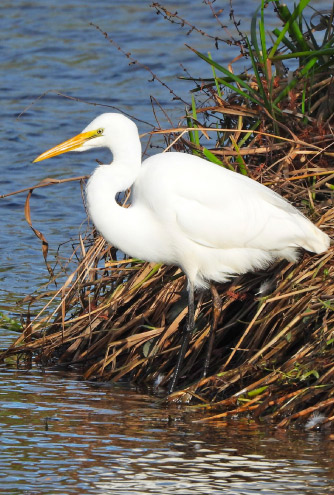
More recently, kōtuku (white heron) have also been observed within the wetlands. With only a small population (approximately 150 – 200) remaining in Aotearoa New Zealand, sightings of this rare and revered bird are significant and reflect the value of restoring and protecting wetland environments.
A joint medium-term goal between Quayside and Tapuika is to initiate a cultural environmental monitoring programme within the wetlands. This will involve regular and ongoing observations of the natural environment, blending mātauranga Māori, traditional concepts, and Western science to be able to assess and report on changes in the environment and ecosystems providing a basis for any potential adaptations of approach and maintenance. This will be an iwi-led long-term programme that will feed into the history of the Rohe for future generations.
The ecological success of Te Haukōpūpū is the result of a partnership between Quayside and Tapuika, combining infrastructure delivery with kaitiakitanga and mātauranga Māori. Together, the wetlands are improving water quality, strengthening biodiversity and creating a lasting environmental asset that will benefit the region for generations to come.
Cultural Outcomes
Cultural elements are woven into the places, spaces and experiences across the development, giving the business park depth, identity and meaning.
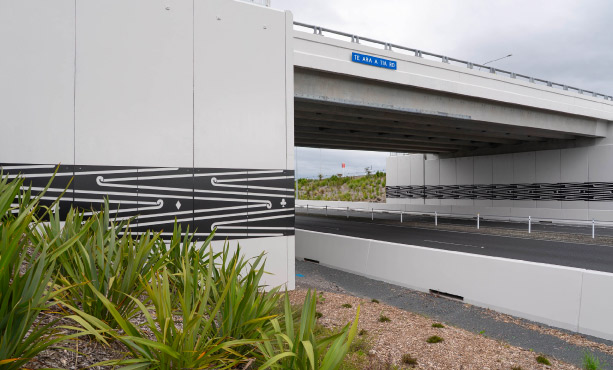
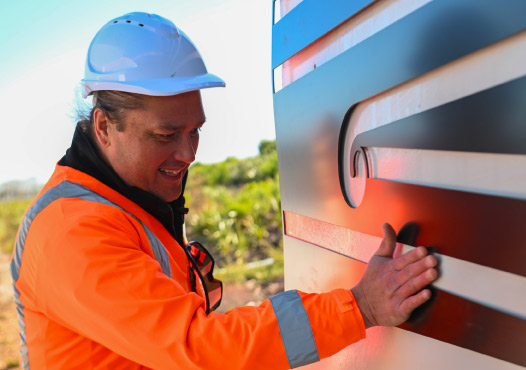
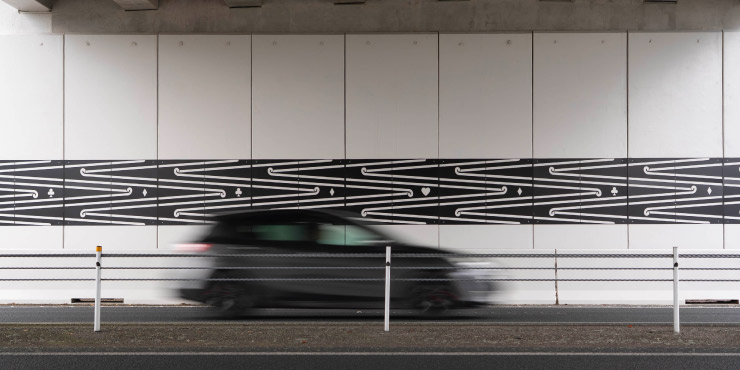
One example is the design of the bridge abutments, which draws on a traditional puhoro pattern unique to Te Arawa. Historically used on the hulls of waka, the pattern represents speed and agility through movement across water. Reinterpreted for Rangiuru Business Park, it reflects the movement of vehicles along the Tauranga Eastern Link and the transition as they enter the business park. Beyond its visual impact, the design provides a visible expression of mana whenua identity, ensuring Tapuika can see themselves reflected in the landscape and reinforcing a sense of belonging and connection to place.
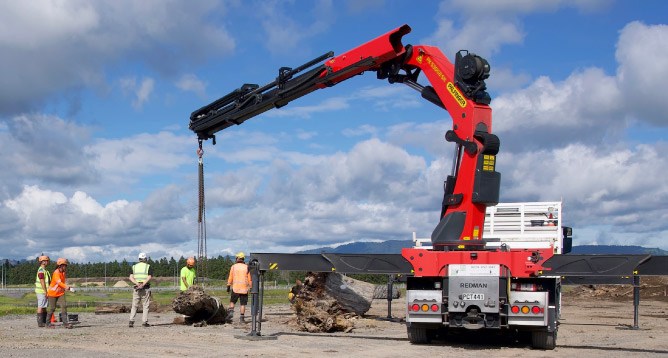
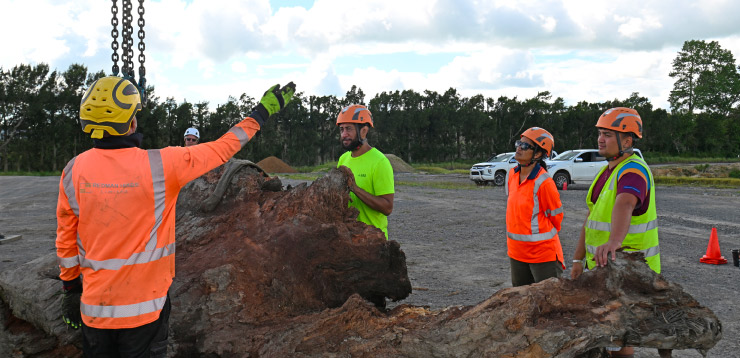
The partnership is also creating opportunities for cultural expression beyond the built infrastructure. During stormwater works, native logs were uncovered and carefully removed from site. Tapuika Iwi Authority staff undertook NZQA-accredited training in load slinging to support the work, with the logs now being retained for carving and the creation of cultural features that will become part of the wider business park landscape.
That same commitment to cultural expression has informed the evolution of the Rangiuru Business Park brand. Developed in collaboration with Tapuika, the refreshed identity better reflects the significance of the name Rangiuru and the history of the whenua. The new logo includes elements that draw inspiration from the wetland Pukaingataru, referencing the harvesting of kūmara and the enduring relationship between people and land. It speaks to nourishment, cultivation, and abundance. It’s also inspired by the Poutama pattern, symbolising growth, learning, achievement, and continual advancement. Together, the forms represent the connection between past, present, and future generations, and the partnership between Tapuika and Quayside as kaitiaki and stewards of the region’s future.
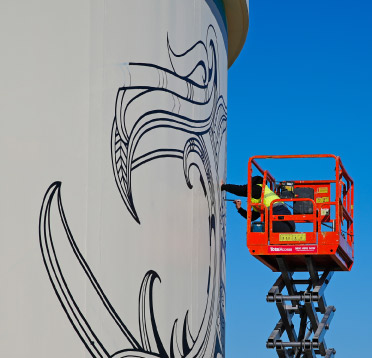
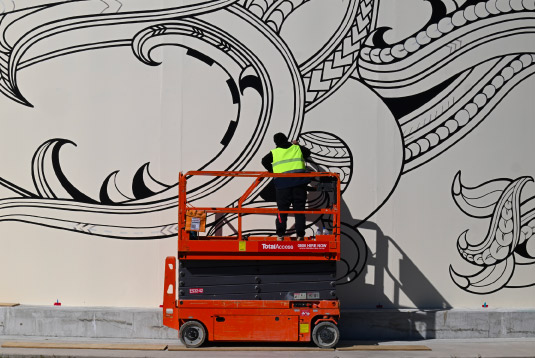
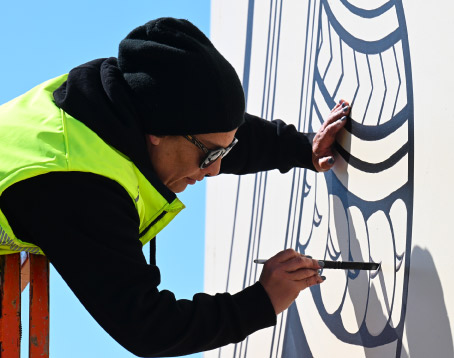
Cultural storytelling is also being incorporated into the development’s built environment through public artwork, including the water reservoir where local Tapuika artist Robyn Williams will bring to life the story of Whakaotirangi, who brought the seed of the kūmara to Aotearoa on her voyage on the Te Arawa canoe.
The result is a business park that reflects more than economic development. It demonstrates how cultural identity, partnership, and long-term stewardship can be woven into the fabric of a major regional asset, creating a place that honours the stories of the past while supporting prosperity for future generations.