INVESTING FOR EVERY GENERATION
How our new Distribution Policy works — and what it means for you.
In 2025, Quayside and the Bay of Plenty Regional Council undertook a thorough, collaborative review of how distributions to Council are calculated. Independent experts were engaged. Scenarios were modelled. Principles were debated and agreed. The result — adopted by the Quayside Board in February 2026 — is the clearest, most transparent distribution framework we have ever had. This article explains how it works, and what it means for every community member in the region.
FY26 distribution
to Council
reducing rates by an average of $405 per rateable unit
Quayside’s investment
portfolio
as at 30 June 2026
Value
per ratepayer
total fund of $3.5 billion
An intergenerational fund for the Bay of Plenty
Our purpose is to grow and preserve the fund across generations — an endowment model in which the capital base is maintained in real terms, so that the returns it generates keep flowing to Council and the community indefinitely. Not just today. Not just for the next Long-Term Plan. Forever.
A process built on collaboration and independent expertise
The revised Distribution Policy is the product of a detailed, structured process carried out across 2025, collaboratively with Quayside’s Board and leadership team, the Bay of Plenty Regional Council, and independent external experts to review and adapt the policy to ensure it was fit for purpose now and into the future.
Designing Quayside’s distribution policy is more complex than for many investment funds because the portfolio has several different objectives and sources of return.
At the centre of the portfolio is Quayside’s majority shareholding in Port of Tauranga. While the investment has delivered exceptional longterm capital growth, the cash dividend yield is relatively modest compared to the size of the holding. As a long-term strategic investor, Quayside cannot simply sell shares to fund annual distributions, meaning the policy needs to recognise the difference between value being created and cash being received.
Quayside also has existing obligations, including annual interest payments on the Perpetual Preference Shares that were issued to fund a special dividend to Council. As a result, not all dividends received from the Port are available to be distributed directly to Council.
At the same time, much of the Investment Portfolio is invested in growth-oriented assets, including international equities, where a significant proportion of returns are generated through capital appreciation rather than cash income. Other assets, such as Rangiuru Business Park, are intended to deliver long-term regional benefits and are not yet producing income.
The challenge was therefore to design a policy that reflects how Quayside’s portfolio actually generates returns, while still providing Council with a stable and sustainable income stream. This is particularly important given Quayside contributes around a quarter of Council’s revenue. The new framework helps manage concentration risk, improve resilience and support more predictable distributions, while preserving the long-term value of the fund for future generations.
The policy was adopted by the Quayside Board on 3 February 2026, following a final briefing to Councillors. It replaces the previous Distribution Policy with a framework that is simpler, more transparent, and explicitly anchored to the longterm stewardship obligations that Quayside holds on behalf of the community.
We are pleased with where the framework has landed. It reflects the unique characteristics of our portfolio, provides greater certainty around future distributions, and helps protect the fund for future generations. Just as importantly, it reflects a shared view between Quayside and the Regional Council about how the community’s assets should be managed over the long term.
Sam Newbury, Chief Investment Officer
Three principles, one policy
The policy was built around three principles agreed by Quayside and Council, and importantly, helped shape the policy and mechanisms used to move forward.
Principle |
What it means in practice |
|---|---|
| Intergenerational Equity | The fund belongs to future Bay of Plenty communities as much as it belongs to people alive today. The real, inflation-adjusted value of our capital must be preserved — not just maintained in name but genuinely protected against the eroding effect of inflation over time. |
| Transparency and Structure | How we calculate the annual distribution is written down, public, and applied consistently. There are no judgment calls or backroom adjustments. Every year’s payment follows the same formula, and Council — and our community — can verify every step. |
| Stability and Predictability | The Regional Council plans its budget years ahead. Distributions need to be steady and foreseeable. The policy is designed to smooth out the natural ups and downs of investment markets, so Council can plan with confidence. |
The foundation of protecting future generations: The Real Capital Floor
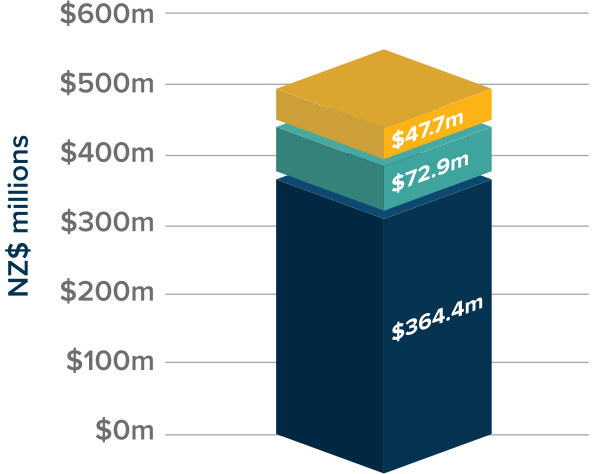
The most important protection built into the new policy is what we call the Real Capital Floor — set at $350 million as at 30 June 2025, and adjusted for annual inflation, it represents the inflation-adjusted value of the Port of Tauranga dividends that Quayside has retained and reinvested over its lifetime. In simple terms, it is the minimum level of capital that must be preserved to help ensure future generations benefit from the fund in the same way current generations do.
As at 30 June 2025, Quayside’s investment portfolio was valued at approximately $427 million — $77 million above the floor. The floor will rise each year with inflation, so it always reflects real purchasing power.
A cushion for difficult years: The Distribution Buffer
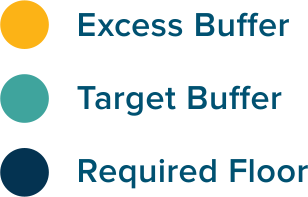
Between the capital floor and our current portfolio sits what the policy calls the Target Distribution Buffer — approximately $70 million of additional headroom above the minimum.
Investment markets are not perfectly smooth. Port dividends can vary year to year. The buffer exists so that a difficult market environment doesn’t automatically translate into an immediate cut to Council’s funding. It absorbs the impact, maintaining stable distributions while Quayside navigates through.
Only if the buffer were to fall significantly, to less than half its target level, would a staged distribution reduction be considered. This is a proactive, transparent mechanism, not a reactive one. Council and the community will always have clear visibility of where the buffer sits.
Capital Adequacy
Floor + Target Buffer + Excess = NAV $485m

How the annual distribution is calculated
The annual distribution is calculated using a transparent three-part formula: a sustainable return on Quayside’s diversified investment portfolio, plus 80% of the net Port of Tauranga dividend, less the independently assessed costs of strategic regional assets, such as the Rangiuru Business Park. This approach balances a reliable return to Council today while retaining capital to grow and diversify the portfolio for the future.
Part 1 · Return on investment portfolio
3-year average value → × (inflation + 2%)

Part 2 · Port of Tauranga dividend
80% to Council
20% retained
Net of Quayside’s own Port-related operating costs
Net of PPS dividend and associated cost

Strategic asset costs
Rangiuru Business Park
Deducted before distributions

Annual distribution
Why we retain 20% of the Port Dividend
One of the most carefully considered decisions in the new policy was the payout ratio on the Port of Tauranga dividend. At 30 June 2026, approximately 85% of Quayside’s total portfolio value is currently concentrated in a single asset: the Port. That level of concentration is something our Board and the Regional Council are committed to reducing over time.
Retaining 20% of the net Port dividend each year allows Quayside to reinvest the 20% and reduce concentration risk.
The appropriate payout ratio was one of the central considerations as part of the independent review in assessing how different ratios affect both the size of Council’s distributions over time and the probability of breaching the Real Capital Floor.
Payout ratio |
What the modelling showed |
|---|---|
| 90% to Council | Median annual payment reaches $99.5m by FY2035 — but carries a 21.8% probability of breaching the capital floor within 10 years. A modest income gain for a disproportionate increase in capital risk. |
| 80% to Council | Median annual payment reaches $93.4m by FY2035, with a 17.1% probability of breach. Delivers strong, sustainable distributions while retaining capital for diversification. |
| 70% to Council | Median annual payment of $87.3m by FY2035, with a 12.6% breach probability. Stronger capital protection, but $6m less per year for Council — not consistent with Council’s strategy. |