A CONVERSATION WITH THE
BOARD CHAIR
Protecting capital. Growing value. Acting intergenerationally.
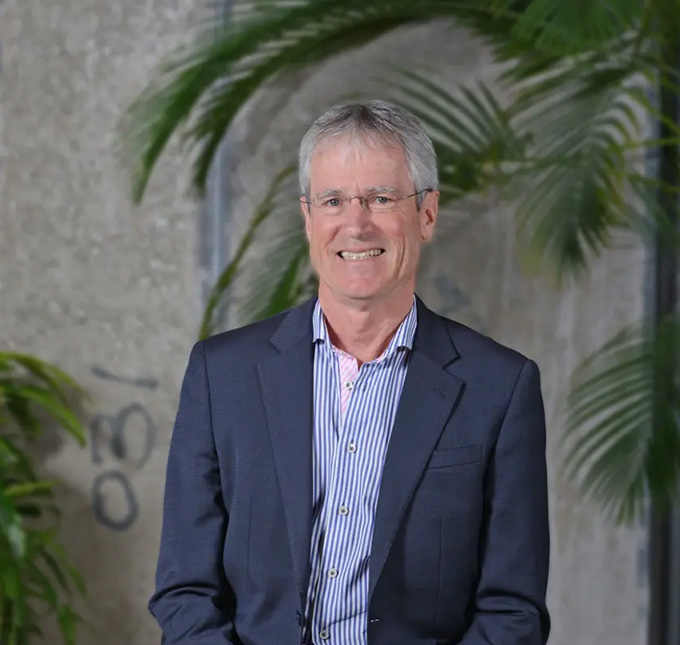
After three years of sharper mandate, clearer strategy and more active ownership, Quayside Board Chair Mark Wynne reflects on what it takes to govern a fund built for both today’s communities and future generations.
A unique role and what matters most
Ask Mark to describe the role of a Chair, and there’s no corporate jargon. “It’s like a supercharged director… often described as a dual role”. Beyond the standard fiduciary, audit and risk obligations, he sees the real value of the role sitting in four places.
Firstly, ensuring the Board stays on strategy and does not dive into management. Taking a “nose in, fingers out” approach. Next is the ability to draw people out around the board table, ensuring every voice is heard, not just the loudest. “When it gets to a point where it’s dominated by one or two, then you’re missing out on value and the power of diversity.”
Thirdly, a genuine emphasis on stakeholder engagement and relationship building, particularly with Quayside’s shareholder and wider network of partners and stakeholders across the portfolio, including the Port of Tauranga, investments and Rangiuru Business Park.
Finally, building a strong relationship with the Chief Executive. “The CE role can be a lonely one. All of management is looking to you, but who does the CE talk to? It is a special relationship and takes time to build trust and confidence, but it’s also critical as a foundation for a high-performing team”.
The value of independence
Quayside’s structure as an investment organisation with a unique civic parentage shapes what it looks for in its independent directors. “The independent directors are brought in for their specialist skills, in terms of investment, commercial and large company management,” Mark explains, while council directors play an equally vital role in tabling “the shareholder and owner’s desires, direction of travel, priorities and issues.” It’s a structure he finds dynamic: “It’s really quite a unique company, being council-owned and a commercial investment company. So it’s quite an exciting and challenging role for an independent.”
A portfolio diversifying
At the close of FY26 over 85% of Quayside’s portfolio sits in its majority shareholding of the Port of Tauranga, a concentration Mark doesn’t shy away from discussing. Best-practice portfolio management points firmly toward diversification, he says, acknowledging New Zealand Superannuation Fund, ACC, and offshore endowment funds as examples of the direction of travel. The Bay of Plenty Regional Council approved a managed sell-down to a floor of 28%, with timing at Quayside’s discretion. “We are taking our time and ensuring we’re not leaving value on the table.”
Should a sell-down go ahead, proceeds would flow back across the portfolio within Quayside’s pre-set strategic asset allocation bands, with regional investment being weighed on its merits, not sentiment.
Growing the Bay of Plenty’s future fund, for our community, for generations to come.
Governing within a CCTO
Having spent much of his career in cooperatives, Mark is well acquainted with the friction that can occur between elected and appointed governance. When asked how the public ownership structure has impacted the way he governs, he replies, “There is an inherent tension for elected members between receiving benefits today, whether through dividends, rebates, or other returns, and maintaining a long-term strategy that creates greater value over time. And ultimately, it comes down to getting clarity of mandate. When the owner is clear about what they really want from the investment, the rest can follow.”
That clarity becomes especially critical when markets turn. “The discipline of the market is a much fiercer teacher than perhaps a discussion with your owner,” he says. “Markets are volatile, and when they go down, that’s when the pressure is really on to be able to deliver for today, let alone protect for tomorrow.” It’s this thinking that has driven eighteen months of work tightening Quayside’s SIPO, strategic asset allocation, distributions policy and treasury policy, all connected so that when conditions turn difficult, there’s a clear process to follow. As Mark puts it: “It cannot be just the loudest shouting person in the room or the biggest opinion. It has to be policy-driven.”
Three years of transformation
Mark points to several major changes during his tenure: a clearer mandate, a simpler portfolio and strategy, performance benchmarking, and a more active ownership approach.
On simplification, he says much of the legacy portfolio consumed significant management time for limited value. Smaller holdings were divested, and the business was reorganised into three portfolios: the Port of Tauranga shareholding, the Investment Portfolio, and Rangiuru Business Park. Time, costs and debt were allocated to each to improve transparency and accountability. Performance is now measured against a Reference Portfolio (a low-cost alternative) and a Strategic Asset Allocation (an enhanced active portfolio providing improved risk and return benefits).
The third shift was becoming a more active investor. “There is a big difference between being active, rather than an activist.” With the Port of Tauranga, this has meant deeper engagement with management and governance, building mutual understanding of aspirations, challenges and opportunities while working within NZX disclosure obligations.
The same approach has been adopted across the Investment Portfolio, with investment partners presenting to the Investment Committee and Board. “It’s real people talking to real people. The performance, opportunities and concerns are shared as we try to drive value together.”
The same ethos applies at Rangiuru Business Park. Mark notes, “We’ve got the biggest manmade wetland in New Zealand, land sales are going well in a tough market, and the first vertical build has commenced.”
Insourcing, cost to serve, and discipline
Insourcing, cost to serve, and discipline Quayside currently keeps its investment function in-house, a model Mark believes is justified by its scale and its focus on the region. “If you have the scale to add more value in-house, then that’s the right model. That’s where Quayside is today, and I think it’s the right call.” But he sees it as a question that should be tested continuously to ensure it’s the right fit for the strategy being deployed.
For now, the numbers support the approach. The Investment Portfolio returned 14.3% this year. The Port typically delivers a dividend yield of 2% to 3%, although Mark notes both dividends and long term capital growth have always driven the Port’s value. If a partial divestment goes ahead, proceeds would be reinvested into the Investment Portfolio, increasing the scale and cost effectiveness of Quayside’s operating model.
Risks and opportunities on the horizon
When asked about the next five to ten years, Mark doesn’t understate the uncertainty. “There is a risk around what happens as a result of the local government reforms, but throughout it’s important that the capital base is protected and grows (at a minimum) of inflation plus some, so that the future generations can enjoy the dividends in perpetuity. The elected members, whatever that looks like post-government and local government reforms, can decide how to spend those dividends. That’s not Quayside’s role.”
But the opportunities, in his view, outweigh the risks. “The opportunities in front of Quayside are enormous as we diversify the portfolio and continue to evolve and improve the operating model.” We want to give Council that opportunity, and the only way we can do that for future generations is by protecting the capital through these changes.”