PORT OF TAURANGA
Over the past year, the Port has reaffirmed its position as a cornerstone of New Zealand’s economy — serving as the country’s largest and most efficient port, and a strategically important national asset. Beyond its operational excellence, the Port continues to lead as a forward-thinking hub for innovation and economic capability.
Our collaboration with the team has been genuinely impressive, reflecting a shared commitment to progress and partnership.
Building Capability and Capacity
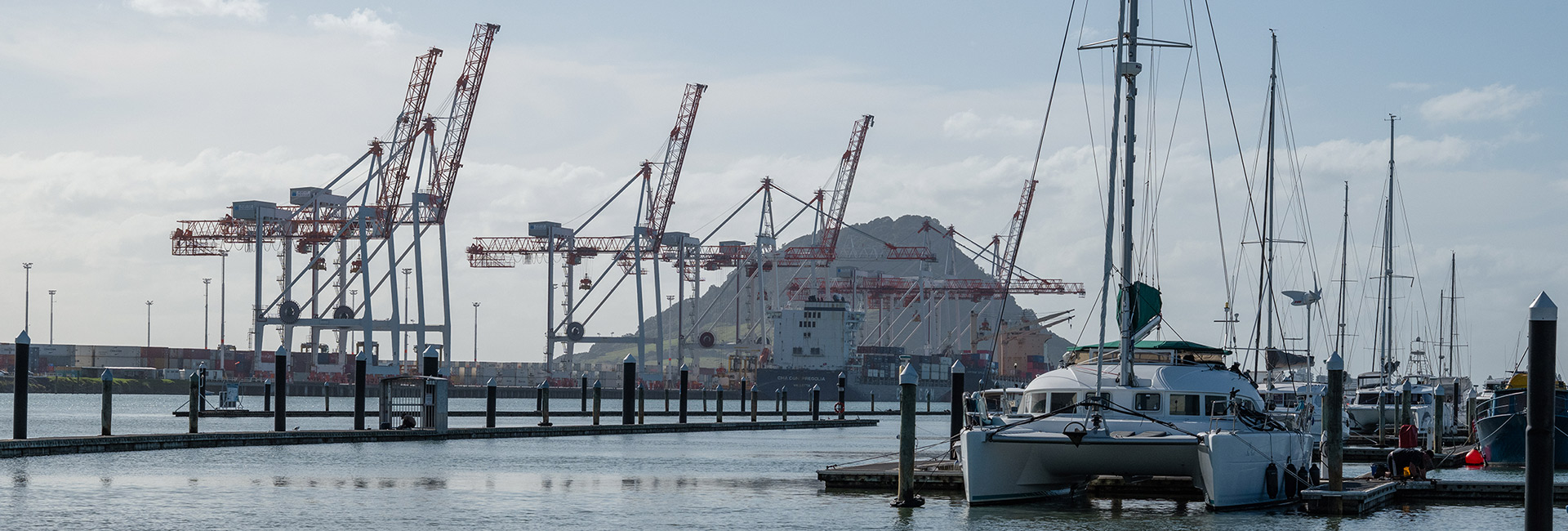
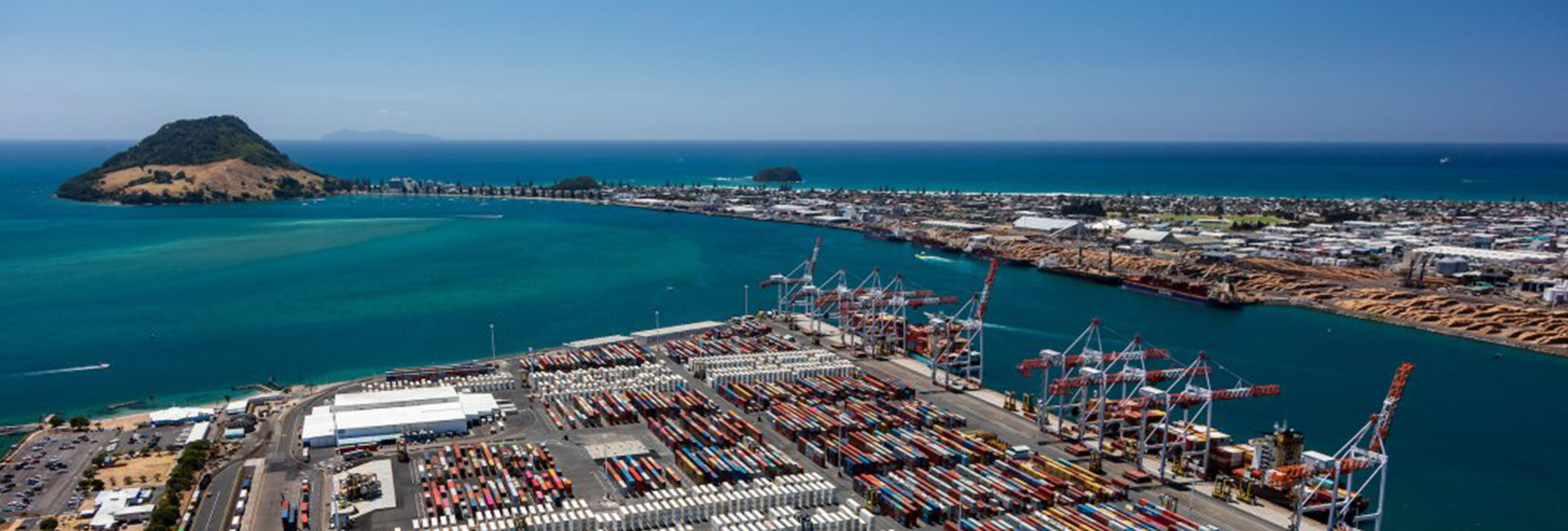
At the centre of the Port’s productivity is its world-class infrastructure. With an annual throughput of more than 1.2 million Twenty-foot Equivalent Unit (“TEU”), the Tauranga.
Container Terminal continues to outperform global benchmarks. The Port’s infrastructure is built to scale, with 3,426 refrigerated container connections, deep-water access, and rail connectivity that links the Bay of Plenty to inland logistics hubs like MetroPort and Ruakura. However, the Port has now reached full capacity — a situation that has been signalled for many years. As a result, shipping lines are increasingly being turned away due to the inability to secure confirmed berth times. This constraint is expected to negatively impact both regional and national growth. Exporting businesses and farmers will face higher shipping costs, while importers may encounter increased expenses that ultimately lead to higher costs for households across the country.
Still, the Port continues to prepare for the next generation of shipping. With capital dredging consented and set to begin in FY26, Tauranga is positioning itself to accommodate larger vessels, ensuring it remains New Zealand’s premier international gateway. Extensions to the Sulphur Point and Mount Maunganui wharves, now progressing through the Fast-Track consent process, will further expand capacity.
In June 2025 the Port sold its 50% stake in Northport to Marsden Maritime Holdings (MMH). This transaction marks the formation of Northport Group Limited, jointly owned by Port of Tauranga (50%), Northland Regional Council (43%), and Tupu Tonu (7%). MMH is now a wholly owned subsidiary of the new entity, positioning Northport for future growth and regional development under a unified governance.
Cargo Trends
Trade volumes through the Port have grown steadily, with total cargo increasing 7% in the 12 months to 30 June 2025. Container volumes rose by 5%, driven by strong export demand, including a record kiwifruit season.
Breakbulk volumes also saw modest growth, although MetroPort volumes decreased due to higher rail costs and a reduction in train frequency. Despite this, capacity utilisation improved, reflecting the Port’s ability to adapt to changing logistics dynamics.
Log exports declined compared to the previous year, largely due to the absence of windthrow volumes that had boosted 2024 figures. Kiwifruit volumes increased 30%, with nearly all of New Zealand’s harvest shipped through Tauranga. Dairy exports rose by nearly 2%, and meat exports climbed by almost 10%, with transhipment volumes more than doubling.
Environmental and Climate Initiatives
The Port continues to progress in reducing its environmental footprint, with air quality monitoring showing reduced dust at the Port boundary. A comprehensive dust source apportionment study in nearby residential areas has just been completed, and a new stormwater treatment system at the Mount Maunganui wharves is under construction to further protect harbour health.
The Port’s terminal automation project is another leap forward in environmental performance. Once implemented, it is expected to produce 75% fewer greenhouse gas emissions compared to an equivalent diesel straddle carrier operation.
Supporting the Primary Sector
The Port’s performance remains closely tied to the strength of New Zealand’s primary industries. In 2024, the kiwifruit sector delivered a record crop, with export values reaching $3.5 billion — representing a 30% year-on-year increase. It’s important to note that the kiwifruit season spans two financial years, and this growth reflects strong performance across both. The industry managed the increased volumes with confidence, supported by excellent fruit quality and an early start to the 2025 harvest. Dairy exports also saw gains, buoyed by favourable weather and global supply constraints, while meat exports increased despite ongoing global economic challenges. The Port’s ability to efficiently manage these critical exports continues to play a vital role in supporting New Zealand’s trade competitiveness.
Trading Performance and Market Confidence
Financially, the Port delivered a strong result, with group net profit after tax reaching $173.4 million for year ending 30 June 2025. Investor confidence remains high, and the Port continues to trade at a premium to its sector peers, reflecting its strong fundamentals, strategic positioning, and disciplined capital management.
Governance
Quayside is the majority shareholder in the Port and while the Port operates independently as an NZX-listed company, Quayside fulfils its duties as a responsible long-term shareholder through strong governance, performance monitoring, strategic oversight and ongoing regular engagement.
Financial Performance
The Port had a Group Net Profit After Tax result of $174.0 million for FY25. Revenue was $447.7 million, compared with $417.4 million in 2024, which is an increase of 7.3%.
Key statistics:
- TEUs increased 5.3% from 2024 to 1,208,252
- Total trade increased to 25.3 million tonnes
- Ship visits increased to 1,442
- Health & Safety: Total Recordable Incident Frequency Rate (TRIFR) of 4.1 per million hours worked for the Port of Tauranga and 16.0 per million hours worked for Port of Tauranga and contractors combined – a 21% increase on 2024.
A Total Ordinary Dividend of
per share has been declared by the Port compared to 14.7 cents per share in 2024.