CONNECTING CAPITAL AND CARGO
A Conversation with Fraser Whineray
Fraser Whineray’s dual directorship with Quayside and the Port is designed to strengthen the strategic alignment between two of the Bay of Plenty’s most important economic entities.
The Port Companies Act 1988 requires that no more than two directors on a Port Board can be members or employees of a shareholding local authority, in this case the Council. In accordance with the [LGA] the Council has adopted a Directors Appointment and Remuneration Policy for Directors of Council Organisations. That policy provides for the appointment of one independent Quayside director and one Council member to the Port’s Board. Quayside implements that policy by exercising its rights as majority shareholder to appoint the Council’s nominated director to the Port’s Board. This ensures the Council has independent Board representation at the Port, supporting the Council’s interests through Quayside as the shareholder, and nurturing clarity and collaboration across both organisations.
Whineray’s approach is centred on improving engagement between the boards of Quayside and the Port. He sees the role as a facilitator of understanding — someone who can interpret the different “languages” spoken by each board and help avoid miscommunication, inefficiencies, and missed opportunities.
He works closely with leadership figures, including Board Chairs Mark Wynne and Julia Hoare and CEOs Lyndon Settle and Leonard Sampson, to support this. A key part of his focus is on context sharing — ensuring that both organisations have a clear and consistent understanding of the strategic environment they each operate in. This is never a set-and-forget approach, rather requires continuous effort to avoid blind spots and maintain contextual currency.
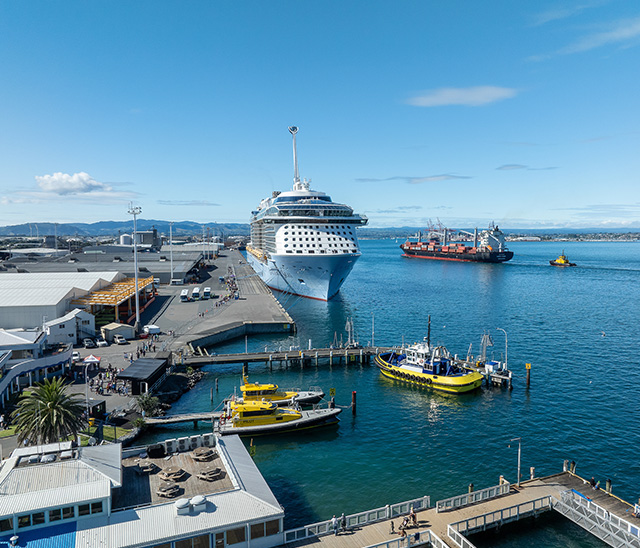
“The Port of Tauranga handles almost 40% of New Zealand’s container cargo, serving hundreds of exporters and importers. Its ability to provide direct shipping access to (and from) global markets, without relying on transhipment through Australian ports is essential for New Zealand trade”.
Fraser highlights the interconnected nature of the Port’s operations, where factors like dredging, ship size, carbon emissions, and reliability all influence outcomes. He stresses the importance of long-term partnerships, including with major shipping lines, exporters and other logistics providers, to secure better services, freight rates and lower emissions.
Drawing on his years of experience as COO at Fonterra, Fraser brings a customer-focused lens to supply chain resilience. He recalls the challenges of maintaining reliable logistics during the COVID-19 pandemic, when long dwell times and unreliable shipping services added costs and complexity for exporters. His emphasis is on ensuring that all parts of the supply chain ecosystem, from port operations across New Zealand, to inland logistics, work together seamlessly.
The Northport expansion, which aims to improve infrastructure and logistics capacity across the Upper North Island, involves significant complexity, but Fraser comments, it will support the growing Auckland region and transform the traditional “golden triangle” of Auckland, Hamilton, and Tauranga into a more integrated “diamond” that includes Northland.
Port and associated logistics infrastructure needs to be delivered ahead of when it is needed, otherwise the country’s economic and social wellbeing are eroded.
As a Quayside Director, Fraser supports the purpose of growing an Intergenerational Fund, which is designed to preserve capital in real terms — maintaining its purchasing power over time. Quayside currently has a value north of $19,000 for every ratepayer. Fraser says the whole team at Quayside feels the protection and growth of every ratepayer’s share of Quayside very keenly.
Fraser advocates for maximum transparency in how the fund’s purpose and usage are defined and communicated, ensuring it remains a reliable source of value for future generations. He also encourages a culture of curiosity and continuous improvement within Quayside, focusing on opportunities rather than constraints and helping the organisation stay aligned with its long-term goals. Fraser is very positive about the progress being made within both organisations; both on improving themselves and outcomes for the many beneficiaries of their activities.
Fraser is a strong advocate for innovation in logistics and port operations. He has shared insights from his visit to the Port of Rotterdam, where he observed fully automated infrastructure including cranes and container stacking systems. With the proposed Port of Tauranga expansions, he looks forward to similar automation at the Port, with benefits including improved efficiency and customer service levels, reduced safety risks, and lower carbon emissions through the use of electric systems.
Fraser’s dual role is grounded in a clear strategic purpose: to improve coordination and support the sustainability and prosperity across Quayside and the Port. His focus on context, collaboration, and customer outcomes is helping both organisations navigate complexity and deliver intergenerationally for the ratepayers, for the region, and for New Zealand.